
Mobile First seriously: Common mistakes that companies make when adapting their websites to mobile phones
Discover the fatal mistakes that sink your mobile sales and how a true Mobile First design can boost the conversion of your digital business.

You’ve probably heard the term “Mobile First” ad nauseam. However, the vast majority of companies get it wrong. They believe that adapting a website to mobile simply means taking the desktop design (for large screens) and shrinking it to fit on a phone.
This is not “Mobile First”; This is a reactive design that, in practice, results in a frustrating user experience. Thinking mobile first means designing the experience from the ground up for small screens and then expanding it to larger screens from there.
“More than 60% of global web traffic and the vast majority of purchasing decisions in Ecommerce today begin from a mobile device.”
If your website is just “shrinking,” you are losing money every day. Below, we analyze the most common mistakes that companies make in their mobile versions and how to solve them to stop losing sales.
The loading speed error (Heavy pages on 4G networks)
Imagine a customer trying to access your online store while traveling on public transport with an unstable 4G connection. If your website was designed first for computers, it probably loads huge images, background-heavy videos, and unnecessary lines of code.
The result is a very high bounce rate (the percentage of users who leave your website without interacting). In the mobile world, users have no patience. If your page takes more than three seconds to display useful content, the visitor will close the tab and move on to your competition. A truly design Optimized prioritizes performance, compressing images and loading only the elements strictly necessary for the initial screen.

Impossible buttons and the “thumb” rule
On a computer, the mouse cursor has the precision of a needle. On a phone, we navigate with our fingers, which are much more imprecise.
A classic mistake of shrinking a desktop website is that the links, “Add to cart” buttons and menus are too small and close together. This causes the dreaded misclick syndrome, where the user tries to press a button and accidentally touches another, ruining their experience. navigation.
The natural area of the thumb
A good “Mobile First” design respects the human anatomy. Most users hold the phone with one hand and navigate with their thumb. Primary buttons (such as calls to action) should be large, spaced wide, and located at the bottom or center of the page. screen, where the thumb reaches naturally and effortlessly.
Endless Forms and Checkouts
In an Ecommerce, the checkout moment (payment process) is the most critical. If you ask a mobile user to fill out a form with 15 required fields on a tiny virtual keyboard, you’re killing your conversions.
Nobody wants to write a novel on their cell phone to buy a product. Long forms are the main cause of cart abandonment on mobile.
The solution?
- Reduce fields to the absolute minimum (name, email, shipping address and payment method).
- Enable native cell phone autocomplete.
- Offer quick one-click payment buttons, such as Apple Pay or Google Pay, so the user can check out using their fingerprint or facial recognition.
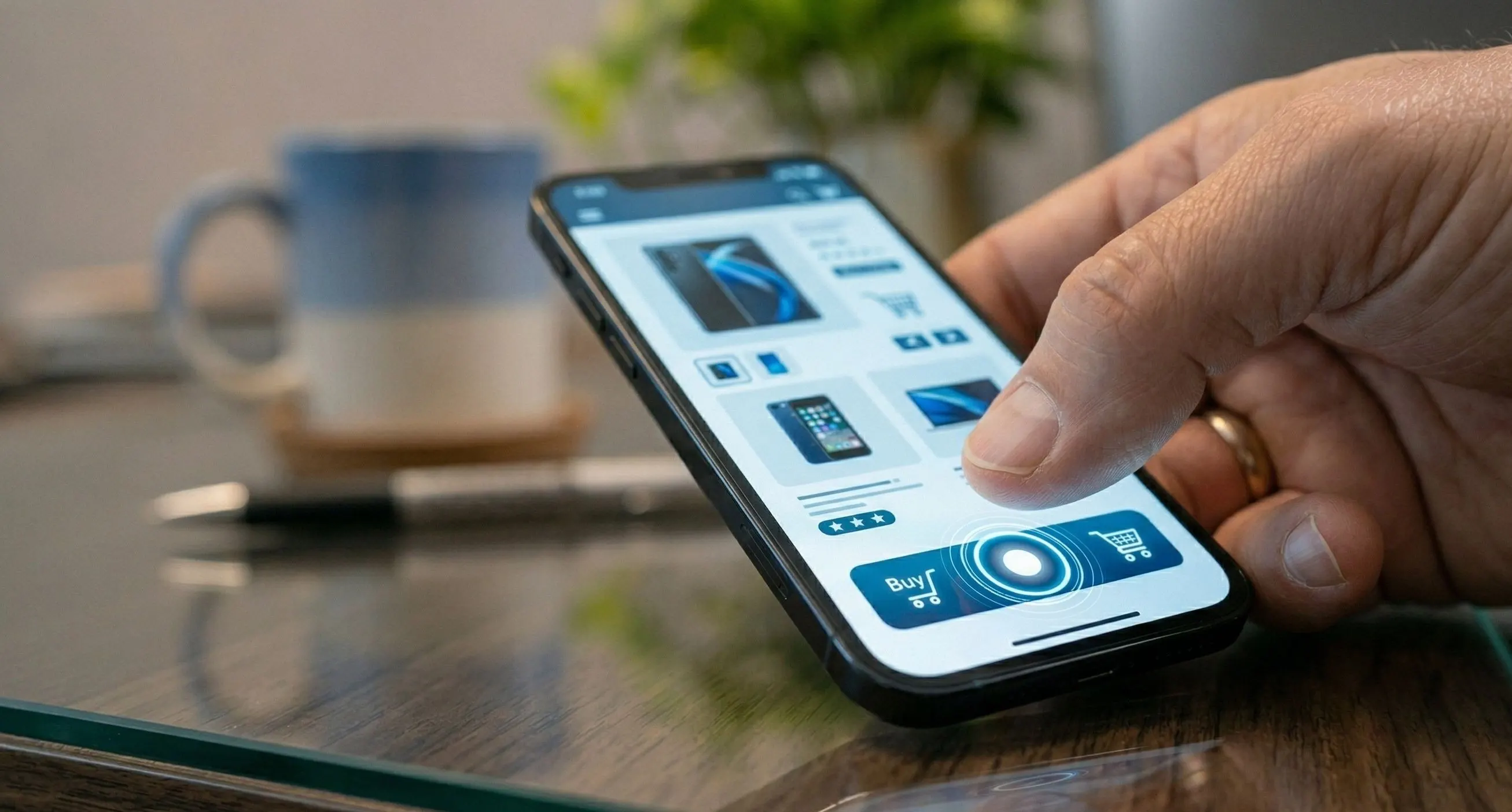
What does a true Mobile First design look like?
A digital product designed for mobile from its conception not only looks different, but works fundamentally different under the hood.
Using modern development technologies, we ensure that the website does not completely reload every time you touch a button, creating a feeling of immediacy identical to that of a native application installed on the phone.
A true Mobile First design includes:
- Clear information hierarchy: Larger and more legible texts, hiding secondary menus behind drop-down buttons so as not to clutter the screen.
- Adaptive images: The server automatically detects that it is a cell phone and sends a much lighter and correctly sized image.
- Instant response times: Removing junk code and optimizing server load so that browsing flows without interruptions.
Stop losing clients in the palm of your hand
I propose a quick exercise: take out your cell phone right now, go to your own website and try to buy a product or fill out the contact form using only one hand. If you’re feeling frustrated, confused, or the page is slow to load, that’s exactly what your customers are feeling. potentials every day.
At our agency, we do not shrink web pages; We build digital sales machines designed for modern consumer behavior. If you’re ready to stop losing sales due to a poor mobile experience, contact us. We will audit your website and design a Mobile solution First that converts your mobile visits into loyal customers. Talk later?